Sunday, April 5, 2009
dentist
Alex has a cavity the size of the national debt. Luckily I have a dentist who likes my art! One cavity=one Gardega original..Now the fun part---I can almost hear that drill. I have a fear of dentists greater than a fear of not being a successful artist. Put me to sleep and wake me when its over.


Leonardo learning---Manila

I forget that people actually read this thing so I am surprised when I am contacted by a person from another country. I was recently contacted by someone from Manila, the capital of the Philippines and I decided it was a perfect chance to interview someone from another country so I could learn about Manila from a person who lives there as opposed (in addition) to reading about it online...I did online research-- post interview. There is much I didn't know about Manila, especially America's involvement in a brutal war there starting in 1898--- I know little about history unless its "Art History"
Please contact me if you are from another country so I can interview you!
Here is the interview with Rachell from Manila in the Philippines:
ME: how did you first hear about my blog? what media source?
10:57 AM Rachell: uh-oh
that was a long time ago...i honestly don't remember
10:58 AM me: thats okay..
Rachell: were you profiled in places like gawker?
plus, with stumbleupon...i have no clue
me: tell me a brief bit about your life and career in manila!
10:59 AM Rachell: well, i work a lot with movie and tv personalities
everyone thinks its glamorous, but it isnt
11:00 AM im not a party person per se, hate the see and be seen crowds, so i stay away from the "glamorous" bits :D
but it is fun, and i do enjoy what I do
styling taught me to iron! hahaha
well, a bit
11:01 AM maids are pretty common in manila, and i've always had them
i dont really need to iron my own clothes, so learning to iron because of my work is kinda funny
me: ha ha
Rachell: what else?
i just finished an out of town shoot yesterday
me: what can you tell me about manila as far as culture and life etc?
11:02 AM Rachell: with a 5am calltime!
culture? there's always something happening
plays, musicals, exhibits, concerts
me: vibrant?
Rachell: pretty much
11:03 AM if the invites i get on facebook are any indication
there's always something or the other, you just need to check the papers
11:04 AM me: what is the food like? can you explain the cuisine?
Rachell: filipino food, unlike the rest of asia, isnt very popular in the west
not because it doesn't taste good, it does
it just isnt very aesthetically pleasing
11:05 AM a lot of sauces, mostly brown
chopped up ingredients, so everything looks like a lump of something
me: a lot of meat?
Rachell: plus, we have a lot of spanish influences, due to the fact that we were under spanish rule for 400 years
11:06 AM meat, vegetables, seafood
everything is represented
dishes made from internal organs are popular, to the disgust of foreigners hahaha
of course, the ever popular balut
11:07 AM me: what are the main fruits and vegetables?
Rachell: subject of countless fear factor dares
mangoes are the most popular
and bananas are endemic
lots of pineapples
lychees, guavas, papayas
melons, watermelons
me: what is your favorite food?
11:08 AM Rachell: loads of fruits
we are a tropical country
favorite in what sense? i eat everything
me: do you have a favorite artist?
Rachell: and eating out is part of life in general
11:09 AM well, i graduated with a bfa
but am sad to say I don't follow the art scene much these days
11:10 AM me: you can choose from all of art history, living or dead.
Rachell: hmm
let me ruminate on that for now
11:11 AM as i have to think if the artists i liked before are still the ones i like now
me: okay...what else can you tell me about life in Manila?
11:12 AM Rachell: manila is very cosmopolitan, with strong american influences in the way of life
me: game shows?! awesome!
Rachell: i think it's one of the "least asian" cities in asia
yes, a lot of game shows
11:13 AM the poor treat game shows as their ticket to a better life
me: 90210? and dancing with the satrs?
11:14 AM what is the currency and main exports?
Rachell: dancing with the stars, no one actually brought it to the local channels
because you dwts is full of has-beens which the general public here may not recognize
lol
11:15 AM 90210 is here tho
gossip girl
most of the shows in the top 20
heck, even "the view" is shown on cable :P
currency is the philippine peso
11:16 AM im not quite sure what our main exports are
off the top of my head, i'd say fruit (we have dole plantations here)
garments
me: and the beaches are beautiful? correct?
Rachell: a few metals like copper
yes, they are
check my palawan folder on fb
11:17 AM me: who is the president?
Rachell: ugh
gloria macapagal arroyo
very corrupt
:P
no one actually likes her anymore
me: not well liked?
11:18 AM Rachell: but with several people power revolts under our belt, people have become apathetic
me: is the judicial system fair?
Rachell: skewed to the rich and powerful
corruption IS rampant
we are third world country you know
11:19 AM a(
me: sounds like america!
Rachell: a*
yes
we were under american rule for years
me: tell me about the caost.
coast
Rachell: and imbibed more than our fair share of your culture
which coast?
7107 islands
LOTS of coastlines
:S
:D
11:20 AM me: where is your favorite place to go?
Rachell: camiguin! i've only been once and am raring to go back
its a tiny island, but i love how laid-back it is
11:21 AM and food is terrific
11:22 AM me: sounds like a nice place, roughly what is population of manila?
Rachell: millions
i have to check online for the current census
in my head, its 6 million but i dont know how accurate my head is
hahaha
11:23 AM me: no problem, I will look it up..what else comes to mind? ---religion...
11:24 AM Rachell: wikipedia says 19mil :O
religion? largely roman catholic
with pockets of the muslim faith in the southern islands
me: is there strife? religious strife?
Rachell: but a lot of other religions are well-represented
11:25 AM well...the rebels are mostly muslim
me: what is a given day like for you in manila?
Rachell: i don't have a regular schedule as im freelance
11:26 AM so my day to day schedule is all over the board
i can sleep the day away
or not sleep for 48 hours, depending on work load
11:27 AM me: explain your work in a bit more detail
11:28 AM Rachell: well, i bring the clothes models and movie stars wear in tv shows and pictorials
so, im in charge of sourcing everything clothing related
11:29 AM i have to get in touch with brands and designers to loan me the clothes
and then return them afterwards
i dress them up during work proper
me: are they nice or are they spoiled?
Rachell: help with poses and give feedback on lighting during fashion editorials
11:30 AM some are nice, some are spoiled
depends on the person
the most successful ones are usually nice
or at least can act nice :D
11:31 AM me: do you find yourself introducing family and friends to their favorite stars and having to get autographs for people?
11:32 AM Rachell: nah
im the least star struck person
hahaha
11:33 AM me: but your friends!
now, what is the most popular show on TV that is not a US import?
11:34 AM Rachell: noon time variety shows are very popular
and the local soaps during prime time
11:35 AM there are two main, competing channels: abs-cbn and gma-7
and several bit players
plus the cable channels
me: well, I think we covered a lot. what is the big sport over there? is it soccer?
Rachell: basketball!
11:36 AM for a country where height is not a big feature in physical attributes, we do love basketball
me: never would have guessed that.
Rachell: no one in their right minds would
hahaha
i told you, american influence
11:37 AM me: who is the most famous Manilan? Is it the inventor of the Manila Envelope?
Rachell: every small village and barrio has their own league
most famous???
hmmm...again, the question is too broad
im not quite sure who to answer
11:38 AM and did the manila envelope actually come from manila? hahaha
me: that is fine...tough to answer that in any nation...
I want to thank you for the wonderful interview and for giving me this information from a personal point of view about Manila..Leonardo Learning thanks you!
11:39 AM Rachell: leonardo learning?
as in da vinci?
11:41 AM me: Part of my new website. Leonardo was interested in all things universally. I use that approach to learn as much as I can about everything and then to convey the learning on my blog.
Rachell: oh, very cool

 The Battle of Manila Bay.
  Escolta Street in stereoptical view, 1899.
American period (1898-1946)
Further information: History of the Philippines (1898-1946) and Commonwealth of the Philippines

U.S. Troops invaded Manila in 1898 and waged war with the Spaniards and Filipinos in the Spanish-American War and the Philippine-American War. Following the defeat of Spain, U.S. forces took control of the city and the islands in one of the most brutal and forgotten chapters of Philippine American history.
The American Navy, under Admiral George Dewey, defeated the Spanish squadron in the Battle of Manila Bay on May 1, 1898. Admiral Dewey testified that after the battle the Spanish Governor wished to surrender to the Americans rather than the Filipinos, whom he feared.[24]
Having just won their independence from Spain, the Filipinos were fiercely opposed to once again being occupied. Emilio Aguinaldo proclaimed the First Philippine Republic at the Malolos Congress and had begun to build the foundations for an independent nation. Admiral Dewey, however, claimed he never recognized the Philippine Republic, as he did not have the authority to do so and did not consider it an organized government.[25] War broke out between the Filipinos and the Americans on February 4, 1899, when an American soldier shot and killed a Filipino in Manila. The Americans pursued the retreating Filipino forces province by province, until General Emilio Aguinaldo (then president of the Republic) surrendered in Palanan, Isabela, on March 23, 1901.

American high command at that time was headed by General Otis who ordered invasion and occupation. By that time the Filipino troops had taken classic defensive positions around Manila to attempt to keep them out. However, the poorly armed, ill-trained soldiers could not compete with the superior firepower of the Americans and they lost and were severely beaten; so much so that it has been reported that the dead were used as breastworks.[citation needed]
Under the command of Aguinaldo the Filipinos began a guerrilla campaign to resist the new occupiers. This campaign had limited success in the early days following the initial occupation of the Americans although any successes were short-lived. The replacement of General Otis by General Arthur MacArthur, Jr. began an extensive campaign to suppress the local population.
This campaign by the USA has been reported as being a particularly bloody suppression with wild reports of commanders ordering the murder of everyone over 10 years old. Several books have been written on this war and it's implications for both the local peoples and the US. These books are largely hostile to the US: [26]
In the Treaty of Paris in 1898, Spain handed over the Philippines to the United States of America for US$ 20,000,000 and ending 333 years of Spanish rule in the islands. [27][28]
Manila continued under an American military government until civil government was established for the city on July 31, 1901. The Philippine-American War continued through 1903 at the cost of many lives both in Manila and elsewhere in the Islands. In 1935, the United States government committed itself to granting the Philippines Independence after a ten-year transition, a period that was extended by one year due to World War II.
The City of Manila (Filipino: Lungsod ng Maynila), or simply Manila, is the capital of the Philippines and one of the 17 cities and municipalities that make up Metro Manila. Located on the eastern shores of Manila Bay just west of the National Capital Region in western side of Luzon, it is one of the central hubs of a thriving metropolitan area home to over 14 million people.[1]
Manila, occupying a total land area of 38.55 square kilometers,[2][3] is the second most populous city in the Philippines, with more than 1.6 million inhabitants.[3] Only nearby Quezon City, the country's former capital, is more populous. The metropolitan area is the second most populous in Southeast Asia.[1]
Manila lies about 950 kilometers southeast of Hong Kong, 2,400 kilometers northeast of Singapore and more than 2,100 kilometers northeast of Kuala Lumpur. The Pasig River bisects the city in the middle. Almost all of the city sits on top of centuries of prehistoric alluvial deposits built by the waters of the Pasig River and on some land reclaimed from Manila Bay.
The layout of the city was haphazardly planned during the Spanish Era as a set of communities surrounding the fortified walls of Intramuros (within the walls), which was the original Manila. Intramuros, one of the oldest walled cities in the Far East, was constructed and designed by Spanish Jesuit missionaries to keep from invading Chinese pirates and natives uprising. During the American Period, some semblance of city planning using the architectural designs and master plans by Daniel Burnham was done on the portions of the city south of the Pasig River.
Manila is bordered by several cities in Metro Manila such as Navotas City and Caloocan City to the north, Quezon City to the northeast, San Juan and Mandaluyong City to the east, Makati City to the southeast, and Pasay City to the south.
Well into the 13th century, the city consisted of a fortified settlement and trading quarter at the bay of the Pasig River, on top of previous older towns. The official name of the city under its Malay aristocracy was Seludong/Selurung, which was the same name given for the general region of southwestern Luzon at that time, suggesting that it was the capital of Ancient Tondo. However, the city became known by the name given to it by its Tagalog inhabitants, Maynila, first recorded as Maynilad. The name is based on the nila, a flowering mangrove plant that grew on the marshy shores of the bay, used to produce soap for regional trade; it is either from the phrase may nila, Tagalog for "there is nila," or it has a prefix ma- indicating the place where something is prevalent (nila itself is probably from Sanskrit nila 'indigo tree').[4] (The idea that the plant name is actually "nilad" is a myth.)[5]
Manila became the seat of the colonial government of Spain when it officially controlled the Philippine Islands for over three centuries from 1565 to 1898. During the British occupation of the Philippines, the city was occupied by Great Britain for two years from 1762-1764 as part of the Seven Years War. The city remained the capital of the Philippines under the government of the provisional British governor, acting through the Archbishop of Manila and the Real Audiencia. Armed resistance to the British centred in Pampanga.
Manila also became famous during the Manila-Acapulco trade which lasted for three centuries and brought the goods as far as Mexico all the way to South East Asia. In 1899, the United States purchased the Philippines from Spain and colonized the whole Philippine archipelago until 1946.[6] During World War II, much of the city was destroyed. It was the second most destroyed city in the world after Warsaw, Poland during World War II. The Metropolitan Manila region was enacted as an independent entity in 1975.
Manila has been classified as a "Gamma" global city by the Globalization and World Cities Study Group and Network.[7]
Saturday, April 4, 2009
watercolor of the day
 I painted this watercolor to the song the sounds of silence by simon and garfunkel...It just came out of my brush, not sure what it means, a man standing on the moon/ earth stealing a giant feather...
 Hello darkness, my old friend
I've come to talk with you again
Because a vision softly creeping
Left its seeds while I was sleeping
And the vision that was planted in my brain
Still remains
Within the sound of silence
In restless dreams I walked alone
Narrow streets of cobblestone
'Neath the halo of a street lamp
I turned my collar to the cold and damp
When my eyes were stabbed by the flash of a neon light
That split the night
And touched the sound of silence
And in the naked light I saw
Ten thousand people, maybe more
People talking without speaking
People hearing without listening
People writing songs that voices never share
And no one dared
Disturb the sound of silence
"Fools", said I, "You do not know
Silence like a cancer grows
Hear my words that I might teach you
Take my arms that I might reach you"
But my words, like silent raindrops fell
And echoed
In the wells of silence
And the people bowed and prayed
To the neon god they made
And the sign flashed out its warning
In the words that it was forming
And the sign said, "The words of the prophets are written on the subway walls
And tenement halls"
And whispered in the sounds of silence

I never get bored of posting these words
the pass
Proud swagger out of the schoolyard
Waiting for the worlds applause
Rebel without a conscience
Martyr without a cause
Static on your frequency
Electrical storm in your veins
Raging at unreachable glory
Straining at invisible chains
And now youre trembling on a rocky ledge
Staring down into a heartless sea
Cant face life on a razors edge
Nothings what you thought it would be
All of us get lost in the darkness
Dreamers learn to steer by the stars
All of us do time in the gutter
Dreamers turn to look at the cars
Turn around and turn around and turn around
Turn around and walk the razors edge
Dont turn your back
And slam the door on me
Its not as if this barricade
Blocks the only road
Its not as if youre all alone
In wanting to explode
Someone set a bad example
Made surrender seem all right
The act of a noble warrior
Who lost the will to fight
And now youre trembling on a rocky ledge
Staring down into a heartless sea
Done with life on a razors edge
Nothings what you thought it would be
No hero in your tragedy
No daring in your escape
No salutes for your surrender
Nothing noble in your fate
Christ, what have you done?
Proud swagger out of the schoolyard
Waiting for the worlds applause
Rebel without a conscience
Martyr without a cause
Static on your frequency
Electrical storm in your veins
Raging at unreachable glory
Straining at invisible chains
And now youre trembling on a rocky ledge
Staring down into a heartless sea
Cant face life on a razors edge
Nothings what you thought it would be
All of us get lost in the darkness
Dreamers learn to steer by the stars
All of us do time in the gutter
Dreamers turn to look at the cars
Turn around and turn around and turn around
Turn around and walk the razors edge
Dont turn your back
And slam the door on me
Its not as if this barricade
Blocks the only road
Its not as if youre all alone
In wanting to explode
Someone set a bad example
Made surrender seem all right
The act of a noble warrior
Who lost the will to fight
And now youre trembling on a rocky ledge
Staring down into a heartless sea
Done with life on a razors edge
Nothings what you thought it would be
No hero in your tragedy
No daring in your escape
No salutes for your surrender
Nothing noble in your fate
Christ, what have you done?
advice for young artists
Sometimes I have parents or people ask me for advice about art. Not that I am world famous or anything (my hot sauce is, though--woohoo) I have managed, through insane persistence to carve my name onto the oak tree of artists who almost or do have a name. I get my share of press and sell paintings and spend most of my time "in the work" without slaving "for the man" or selling my soul to some corporate Satan where the soul sucking vacuum of conformity will suck the life out of man's art faster than Bernie Madoff will lose your retirement fund. I have walked a very strange path in art, a brutal and rocky, individualistic one. I never followed any leaders and I had very little help along the way. I had stones thrown from enemies and friends alike but I kept on my path and held my eyes on the light at the end of a long dark forest. One must have a personal vision, if you only wish to ape another artist or "a system" you are a lost soul. Copy, copy, copy, others then become yourself. Stubbornness above all is the saving grace of an artist, it will overshadow even talent in the long run. If you have both stubbornness and talent you have a better chance of coming out alive and maybe even with a shiny coin in your pocket-- a gift from the angels of persistence. I was born stubborn, Texas stubborn. Walls will break from my forehead and I will chew stones if I have to follow my vision. Some artists are fine in the commercial realm and that is all fine. If you seek a higher, truer vision of art then you will suffer wolves and plagues and biblical tests of the will that are beyond words for most people. Not to dramatise the life of an artist but the price you pay for a vision is high and it can be smoothed a bit a trust fund or parental money but everything comes with a price. If an artist doesn't get his ass handed too him at least a few times in life, his art will be soft, like a Camembert cheese. Suffering builds character and character is an important ingredient in an artists tool chest. I have known artists with the personality of a chair and I am never surprised when I see that they paint "furniture."--- paintings are not made to match your couch! The rich have their own hell, no worse, no better, just different. I have learned not to judge people anymore, if you are born poor or born rich I only care what is inside you. Many poor people are noble and many rich people are miserable fools, in the end it is the soul that matters. As for advice, if your skin is not thick then you should commercialize yourself above all and make enough coins to have creature comforts. If you have a soul and a pocketful of courage then you can opt for following your own vision of art and all else be damned, plus you will never have a midlife crises nor will you have trouble sleeping or need medicine for your head.
Leonardo Learning--The Atom basics explained
The most perfect shape in the universe is the circle but equally in the running for the most perfect of all perfection is the triangle..It contains the entire universe, the trinity of all wisdom. Everything in the universe is made of atoms. All atoms are made up of a trinity of Protons, Neutrons and Electrons (in varying ratios and numbers) but every atom consists of this "Triangular Trinity of Creation."
Every atom is surrounded by a "cloud" of electrically charged particles called Electrons. The charge of these electrons determines the chemical properties of the atom. i.e the transparency of glass etc
Deep inside the atom (which is essentially empty nothingness--- like the non-universal brain of Sargent) Lies the HEART of the atom----The Nucleus, and it is composed of Neutrons and Protons. Most of The mass in an atom lies in the nucleus--the electrons are basically bit of nothing but electrical "potential.."
a neutron has a neutral charge (as its name suggests) and a proton has a positive charge...
All the 92 elements known to scientists are made from varying combination of "The Trinity" in fact, the
Every Atom is electrically neutral so the number of protons in the nucleus must equal the number of electrons in the electron "cloud"
The chemistry of an atom depends on the number of electrons. The nature of a chemical elements depends on the number of electrons. This is the atomic number..
an atom with one proton is hydrogen
an atom with two protons is helium
three protons is lithium
four protons is borrillium
five protons is boron
six protons is carbon
seven protons is nitrogen
eight protons is oxygen
AND SO ON UP TO 92...
Matter is made of Nothing!!!!!!! (Think about them apples.)
Important Terms
Every atom is surrounded by a "cloud" of electrically charged particles called Electrons. The charge of these electrons determines the chemical properties of the atom. i.e the transparency of glass etc
Deep inside the atom (which is essentially empty nothingness--- like the non-universal brain of Sargent) Lies the HEART of the atom----The Nucleus, and it is composed of Neutrons and Protons. Most of The mass in an atom lies in the nucleus--the electrons are basically bit of nothing but electrical "potential.."
a neutron has a neutral charge (as its name suggests) and a proton has a positive charge...
All the 92 elements known to scientists are made from varying combination of "The Trinity" in fact, the
Every Atom is electrically neutral so the number of protons in the nucleus must equal the number of electrons in the electron "cloud"
The chemistry of an atom depends on the number of electrons. The nature of a chemical elements depends on the number of electrons. This is the atomic number..
an atom with one proton is hydrogen
an atom with two protons is helium
three protons is lithium
four protons is borrillium
five protons is boron
six protons is carbon
seven protons is nitrogen
eight protons is oxygen
AND SO ON UP TO 92...
Matter is made of Nothing!!!!!!! (Think about them apples.)
- atom - smallest piece of an element that keeps its chemical properties
- compound - substance that can be broken into elements by chemical reactions
- electron - particle orbiting the nucleus of an atom with a negative charge (mass = 9.10 x 10⁻²⁸ grams)
- element - substance that cannot be broken down by chemical reactions
- ion - electrically charged atom (i.e., excess positive or negative charge)
- molecule - smallest piece of a compound that keeps its chemical properties (made of two or more atoms)
- neutron - particle in the nucleus of an atom with no charge (mass = 1.675 x 10⁻²⁴ grams)
- nucleus - dense, central core of an atom (made of protons and neutrons)
- proton - particle in the nucleus of an atom with a positive charge (mass = 1.673 x 10⁻²⁴ grams)
Subscribe to:
Posts (Atom)
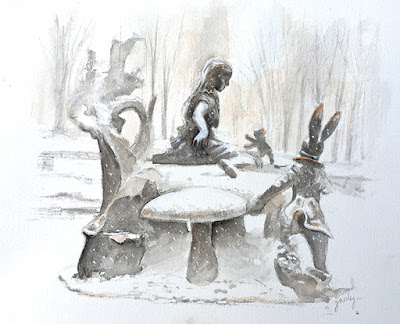
Alice in Winter Watercolor
12 x 16 inches on arches paper to purchase https://tendollarart.com/products/alice-in-winter-watercolor
-
 I was never a huge fan of collage as I thought it a place for people who cannot draw but liked to use scissors and glue. As time went on...
 -
alexgardega@gmail.com 917 400 1317
-
Questions and or comments or simply anything related to art... alexgardega@gmail.com 917 400 1317